
Algorims DocIQ
Documents in. Decisions out.
A cost-tiered AI pipeline on AWS that replaces manual document keying with confidence-routed extraction — cutting document processing cost by up to 97%, hosted entirely in your own AWS region.
Processing feed
Live example- Auto-approved
Invoice · Singapore · Tier 1
JOB-9F21A4 · 0.98 - Auto-approved
Contract · ANZ · Tier 2
JOB-9F21A5 · 0.91 - HIL Review
Claim · India · Tier 3
JOB-9F21A6 · 0.68 - Fields below the signed-off threshold after Bedrock escalation go to a reviewer, never to silent approval.
- Auto-approved
Invoice · Singapore · Tier 1
JOB-9F21A7 · 0.96
- −99.5%
- Cost per document vs. manual + shadow ChatGPT
- −97.4%
- 12-month total cost of ownership
- 1–2 wks
- Payback period on one-time deployment fee
- <45s
- p95 end-to-end processing, ≤20-page document
The opportunity
Your team keys data your AI could read.
Invoices, contracts, claims, and forms arrive as PDFs, scans, and photos — and someone still has to open each one and type the fields into a system of record. It's slow, it's expensive, and it doesn't scale with volume.
Some teams have started pasting documents into ChatGPT to speed things up. That solves the speed problem and creates a bigger one: no audit trail, no confidence scoring, no data residency guarantee, and no way to prove compliance to an auditor.
- 01
Manual keying is slow, expensive, and error-prone across invoices, claims, and forms.
- 02
Ad-hoc use of consumer AI tools solves speed but breaks audit trail, confidence scoring, and data residency.
- 03
Nothing tells you which extracted fields are trustworthy and which need a human look — until it's too late.
How it fits
One layer between your documents and your systems
DocIQ sits inside your existing intake and ERP workflow — it doesn't replace SAP, Oracle, or NetSuite, and nothing leaves your AWS region without a defined, auditable path.
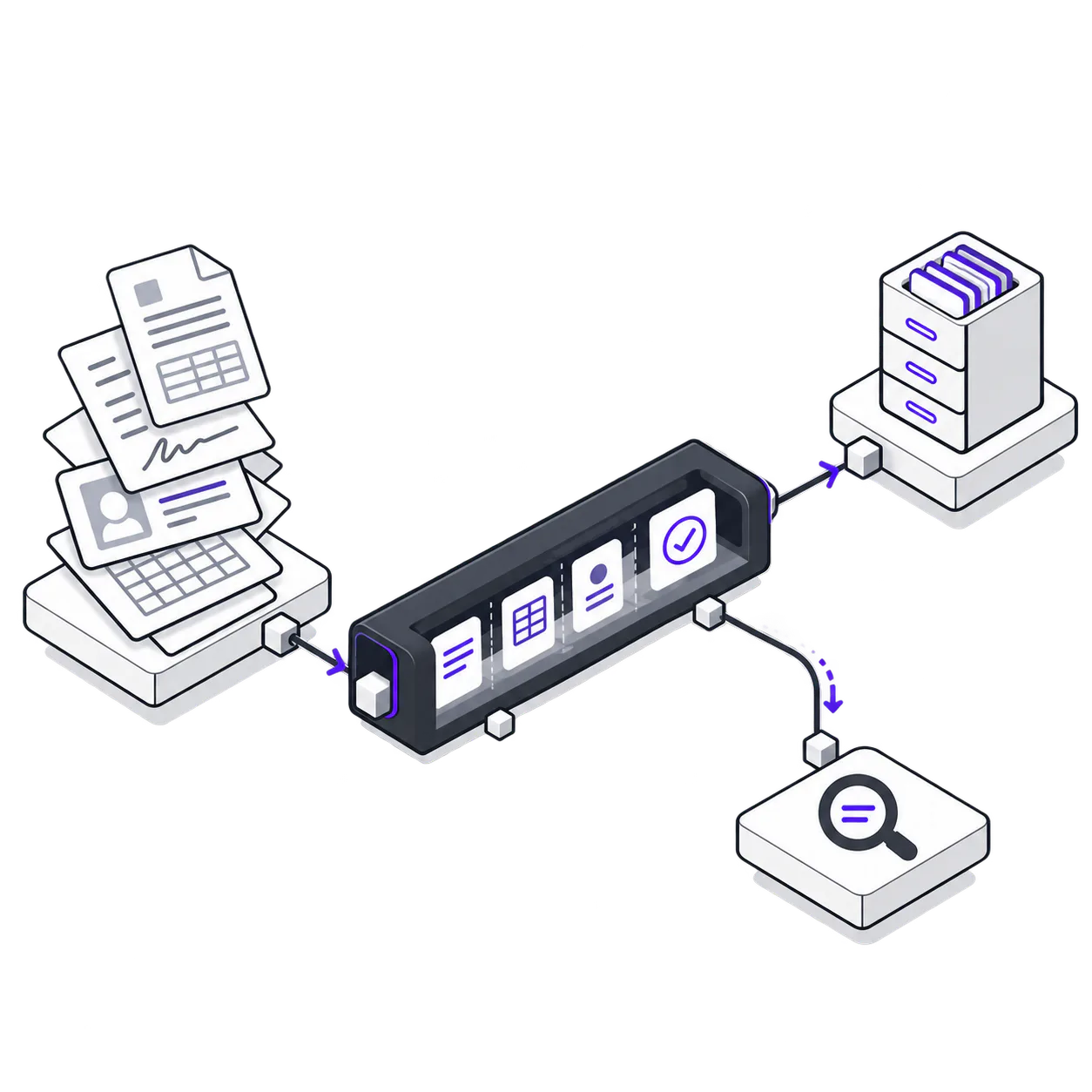
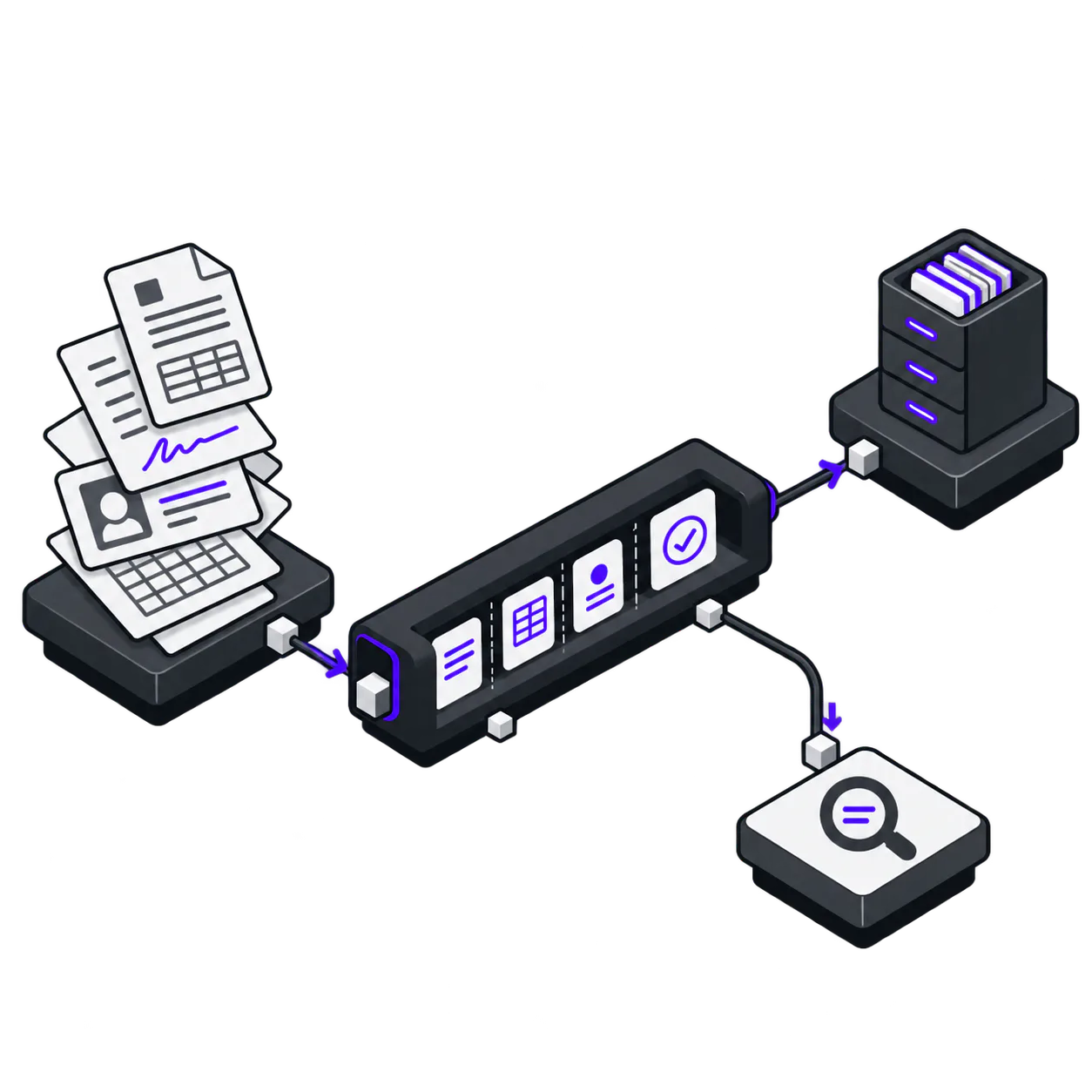
Every step is scoped, logged, and reversible — nothing leaves your AWS region without a defined path.
The workflow
Designed to move fast—and stop at the right moment.
Every document moves through the same confidence-gated pipeline. Most resolve automatically in under a minute. The ones that shouldn't be automated never are.
- 01
Textract extracts
The cheapest tier that reliably reads the document runs first — most pages resolve here.
- 02
Bedrock Claude normalizes and classifies
Fields are normalized, documents classified, and each field confidence-scored.
- 03
Confidence routing
High-confidence documents flow straight through; anything below threshold escalates to a costlier, more capable tier before it ever reaches a human.
- 04
Human boundary
Documents that stay below threshold — even after escalation — always route to a reviewer. AI extracts, humans own exceptions.
- 05
ERP delivery
Approved data posts via an HMAC-signed webhook into SAP, Oracle, or NetSuite.
Production foundation
Built for your environment, not around it.
Extract fast. Verify what matters. Deliver into the systems you already run. Keep control the whole way through.
Amazon Textract
First-pass extraction across invoices, forms, and scans.
Amazon Bedrock (Claude)
Field normalization, classification, and confidence scoring.
HMAC-signed webhooks
Delivers approved data straight into SAP, Oracle, or NetSuite.
Where it fits
The economics,from a reference deployment
Measured at 50,000 documents per month. Textract handles the first pass; Bedrock runs when confidence falls short.
Reviewers own exceptions
The business owner signs off confidence thresholds before go-live. Reviewers receive the document image and a pre-filled extraction overlay, with an agreed response time.
In-region and reversible
Documents and extracted data stay in the client's AWS account and region. Every production cutover has a parallel run and rollback path.
Built-in controls
Deployment commitments
- PDFs, scans, photos, rotated originals, forms, and tables are supported; each field carries a confidence score.
- Results return in under 2 seconds across a searchable archive of more than 1 million documents.
- The reviewer response time is agreed at onboarding. Modeled AI spend and CloudWatch alarms make processing costs predictable.
Regional by design
Built region first, market by market.
Singapore / SEA
Reference architecture already in-region. Dense SME and regional-HQ market with an English-first sales motion.
- AWS region
- ap-southeast-1
- Compliance
- PDPA (SG, MY)
- Currency
- SGD
ANZ
Highest labor cost of the three markets — the biggest per-FTE savings story — with strong AWS adoption and a regulated FSI opportunity.
- AWS region
- ap-southeast-2
- Compliance
- Privacy Act 1988, APRA CPS 234/230
- Currency
- AUD
India
Massive finance-ops, GBS, and BPO document volume, with a strong cost-out culture and shared-services buyers.
- AWS region
- ap-south-1
- Compliance
- DPDP Act 2023, RBI outsourcing norms
- Currency
- INR / USD
Evidence
Measured results
| Metric | Manual + shadow ChatGPT | DocIQ | Delta |
|---|---|---|---|
| Monthly cost | SGD $39,350 | SGD $212.78 | −99.5% |
| Cost per document | SGD $0.787 | SGD $0.00426 | −99.5% |
| 12-month TCO | SGD $472,200 | SGD $12,053 | −97.4% |
| Payback on one-time fee | — | 1–2 weeks of run-rate savings | — |
Reference deployment: 50,000 documents/month. Results vary by document mix and volume.
Operating sequence
A defined path from intake to decision.
- 01
Receive
- 02
Textract
- 03
Bedrock if needed
- 04
Human review if needed
- 05
ERP delivery
Questions, answered
What teams ask before they start.
Does any document leave our AWS region?
No. Every deployment — Singapore/SEA, ANZ, or India — keeps documents and extracted data inside the client's own AWS account and region.
What happens to low-confidence documents?
They escalate to a more capable model tier first; if still below threshold, they always route to a human reviewer.
How is the cost reduction measured?
From a live 50,000-document/month reference deployment, not a model — against fully manual processing.
Ready when you are
Stop payingmanual document-keying prices.
Tell us your document mix and volume — we'll model your numbers before you commit to anything.
Start a conversation